
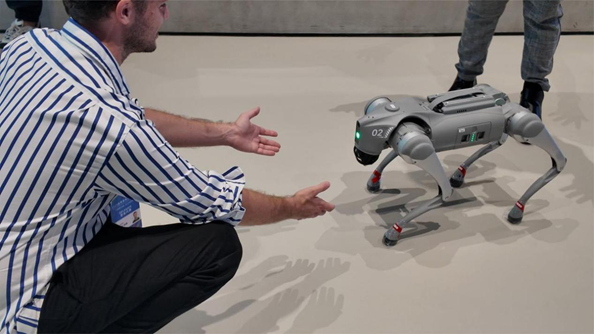
Robotic dogs are selling out but the competition is no longer about "being able to move"
As 618, 18th of June and the mid-year e-commerce sales promotion in China, approached, robotic dog products are experiencing another surge in popularity. On TikTok, the hashtag #roboticdog has garnered over 5 billion views while on Taobao (similar to AliExpress), Pinduoduo (similar to Temu), and 1688 (Chinese factory direct sales app under Alibaba) apps and the number of robotic dog-related SKUs has doubled in the past six months.
But after a stroll, one will notice an awkward phenomenon:
The same product image with a different shell color and a new logo becomes "a new product of another brand". The real difference is no longer in appearance or the number of features.
But after receiving the product:
✅ Can it move immediately after voice command or do I have to wait for half a second?
✅ Can it complete the next three consecutive instructions in one go?
✅ Can it still behave normally while the TV is on in the living room and the child is making noise nearby?
✅ Does it feel like "interacting" or more like "remote control"?
This year, the direction of the robotic dog market is actually very clear: the capability of movement is rapidly becoming very affordable. A quadruped walking solution can be purchased for just a few hundred Chinese Yuan on 1688 app. The focus of competition is shifting from "structural design" to "voice solution" in an all-round way.
01 | Hard to become the bestseller by just relying on "being able to move"
Tearing down a mainstream robotic dog nowadays and the basic action list is like this:
✅ Walking / Running / Jumping
✅ Rolling / Action Performance
✅ Light + Sound Feedback
✅ Remote Control Operation
The pace of functional homogenization is much faster than most people imagine.
★ This implies one thing: hard to become the bestseller by just relying on "being able to move"
02 | Why does voice interaction determine whether a robotic dog is "alive" or "dead"?
Before answering this question, let's first look at a set of data.
A typical voice interaction with a robotic dog goes through the following steps: sound pickup ➡ noise reduction ➡ wake-up ➡ recognition ➡ intent determination ➡ control of motor driver ➡ sound effect playback
★ What users want is the real-time response of "I speak and it moves", akin to talking to a real dog rather than remotely controlling a machine. No solution providers can deliver a good solution if the chip can't handle it. The capability of the chip directly determines the user experience outcome.
To achieve "realistic" experience, the requirements for chips are actually very stringent: sound pickup ➡ recognition ➡ judgment ➡ execution ➡ feedback
03 | GX8006: The key to bringing the robotic dog to life
There are countless voice module solutions available on the market. However, 99% of the solutions only address one thing: converting speech into text. This is not enough for a robotic dog.
What it requires is: hearing clearly ➡ understanding ➡ judging ➡ controlling the motor driver ➡ playing sound effects ➡ preparing to receive the next sentence. This is a whole chain, not a single function point.
In the category of robotic dogs:
★ Voice = The only entry point for interaction
It doesn't have a display like a mobile phone, nor does it have a controller like a game console. The "soul" of the robotic dog lies in its voice recognition capability.
The voice chip directly determines:
✅ How fast is the instruction response (0.8 seconds or 0.1 seconds?)
✅ Can it work properly in a noisy environment? (Will the TV sound cause false trigger?)
✅ Can continuous instructions be executed (Come over ➡ Sit down ➡ Turn around, to be carried out sequentially?)
✅ Does it feel like it's "alive" when used (interaction fluency determines everything)
It also determines whether the product can overcome that hurdle:
★ From "Functional Toys" ➡ “AI Interactive Device”.
At the beginning of its design, GX8006 was not aimed at "adding a voice control", it was aimed at "fully fulfilling the entire interaction link".
04 | Why more and more toy solutions adopt GX8006?
The answer is not complicated. The three biggest headaches for developers when creating a robotic dog solution are:
1. The experience cannot be achieved;
2. BOM cost cannot be pressed down;
3. Poor consistency in mass production.
The reason why GX8006 is being chosen by more and more solutions is because it solves these three problems once for all.
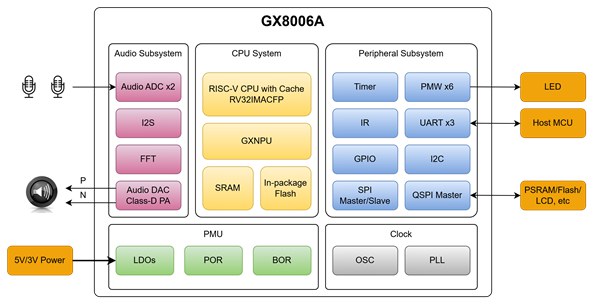
Powerful chip capability: one GX8006 can handle everything
It is powered by 32-bit RISC-V CPU (~200MHz) with built-in gxNPU V122 neural network processor, not relying on the cloud, running algorithms locally with 176KB SRAM and 2MB Flash, 120M QSPI Flash supporting XIP execution and code running directly on Flash to save RAM.
★ This means that AEC echo cancellation, NS noise reduction, VAD voice detection, all of which can be achieved with just one GX8006.
Audio Integration: Audio capture ➡ Processing ➡ Playback
2-channel 16-bit ADC: supports 2-mic array capture;
DAC + built-in 1W amplifier: directly drive 8Ω speaker with no need for external PA to achieve excellent signal-to-noise ratio as well as clear and unobstructed broadcasting.
★ Integrated audio capture and playback with fewer peripherals.
High integration: BOM cost reduction to half is not a dream
Single power supply: 3.0V~5.5V, one LDO without external crystal oscillator;
Built in high-precision oscillator and no need for external Flash;
2MB on chip, with external QPSI for large scenarios and no need for external PA;
Integrated 1W amplifier and no need for external codec;
ADC+DAC fully built-in: compared to ordinary discrete solutions, from 15+peripheral components to less than 5 that resulted in PCB area reduction by 30%~40%. BOM cost is directly reduced and a robotic dog can provide several dollars additional profit.
★ For solution providers: smaller PCB, fewer components, simpler SMT, and higher mass production yield;
★ For brand owners: higher profit margin at the same retail price.
Full interface: One chip connects the entire robotic dog
UART/I2C/I2S/SPI/QSPI: Full coverage of mainstream protocols;
PWM: Control the lighting system;
GPIO: Connected to infrared sensors, touch modules, and collision detection.
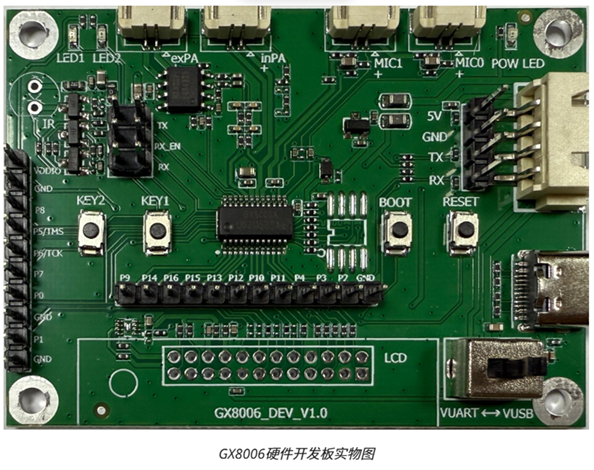
★ Lighting control, Wi-Fi/Bluetooth module, sensors: one bus to connect all with no converter chip required. When the solution provider obtains GX8006, it is basically "able to run immediately after connecting cables".
05 | See the difference after putting it into the robotic dog
★ Hearing clearly: AEC+NS dual algorithm support to allow accurate sound capture even with TV on in the living room
★ Fast response: fully offline millisecond level execution (<0.1 seconds), move immediately after speaking
★ Got it: Continuous command without pause, "Come here ➡ Sit down ➡ Turn around ➡ Get down "in one go
★ Loud: Equipped with a built-in 1W PA direct push speaker, the sound is full and not dull
★ Device saving: Cut the periphery to single digits, make the PCB smaller, and mount faster
★ More like 'live': natural and smooth interaction, still playing on the third day, still playing on the 30th day
in a word:
There is no more trade-off between "good experience" and "low cost" using GX8006.

What is Powering a Robotic Dog that Sells 50K Units a Month?
Back to the question in the very beginning, it is not because it can perform more actions or run faster or jump higher. These features can be easily achieved and available from generic solution providers with small amount of money.
It is because it starts to look like real. It listens, understands and interacts. These features seem simple to achieve but they are highly dependent on the chip capability. And what determines the upper limit of the user experience is not the motor parameters, not the case material, but the voice ability.
The value of GX8006 goes beyond just "adding voice support" but to give the robotic dog a 'soul'. Every time when you want it to come over, it really comes over.
If you are looking for the right solution for AI toys, voice control robotic dogs, AI companion toys for children, voice control devices, smart pets and so on, then GX8006 is the core solution with better cost savings, enhanced user experience, faster time to market.

